I have been following all week the eBird alerts for Travis County showing sightings of a female Hepatic Tanager at Commons Ford Ranch Park in south Austin. This is a very rare species in this part of Texas; it is normally a summer resident of the mountains along the New Mexico / Arizona border and reaching down into the Big Bend region of Texas. It is a year-round resident of southern Mexico and South America.
Today, we made the drive down from Georgetown and got there at about 13:00. We made a tour of the area around the barn where it had been seen but neither saw nor heard the Tanager. In fact, we saw very few birds at all. The exception was a half-dozen Eastern Phoebes noisily hunting and squabbling over choice perches. Oh, and my feet found a fire ant mound for me.
This Phoebe landed nearby after catching a bug right over our heads.
We met several groups of birders hoping to add the Tanager to their lists. One couple had driven down from Fort Worth just to find it. We were encouraged that the bird had been sighted earlier that morning. It finally reappeared at 14:15 and was spotted by other birders after hearing its call in a live-oak tree over the picnic bench behind the barn.
Along with everyone else, I spent the next three-quarters of an hour following its slow methodical hunt for insects from branch to branch, and taking as many pictures as I could. I ended up working without a flash and on a monopod requiring high ISO and making it difficult to recover fine detail.
Below was my best image which shows the major field marks distinguishing it from the other female tanagers: Yellow-orange throat, forehead, and underside; the all-important gray cheeks; plus dark bill and eye-line, and light eye-arcs.
Continuing with my "Birds with Bugs" series, here is a shot of the same bird having caught what appears to be a late instar of the green stink bug on the left and some sort of borer on the right.
Many thanks to those who found this bird originally and helped us see it this afternoon.
This weekend Danielle and I drove down to Warbler Woods, a private bird sanctuary in Cibolo, TX. We had a very relaxing day. Among the birds we saw was this female Scarlet Tanager, listed as a rarity in central Texas as it normally migrates along the Gulf Coast flyway. Perhaps Harvey contributed to blowing this one off course ... or maybe it was just having problems with turn-by-turn directions on its GPS, just like we did getting down there.
After not seeing any Red-shouldered Hawks for a month or so, a pair has been hanging around the yard this week. There are two of them calling in the mornings. The adult breast pattern would suggest that this is our original breeding pair, not the new juveniles.
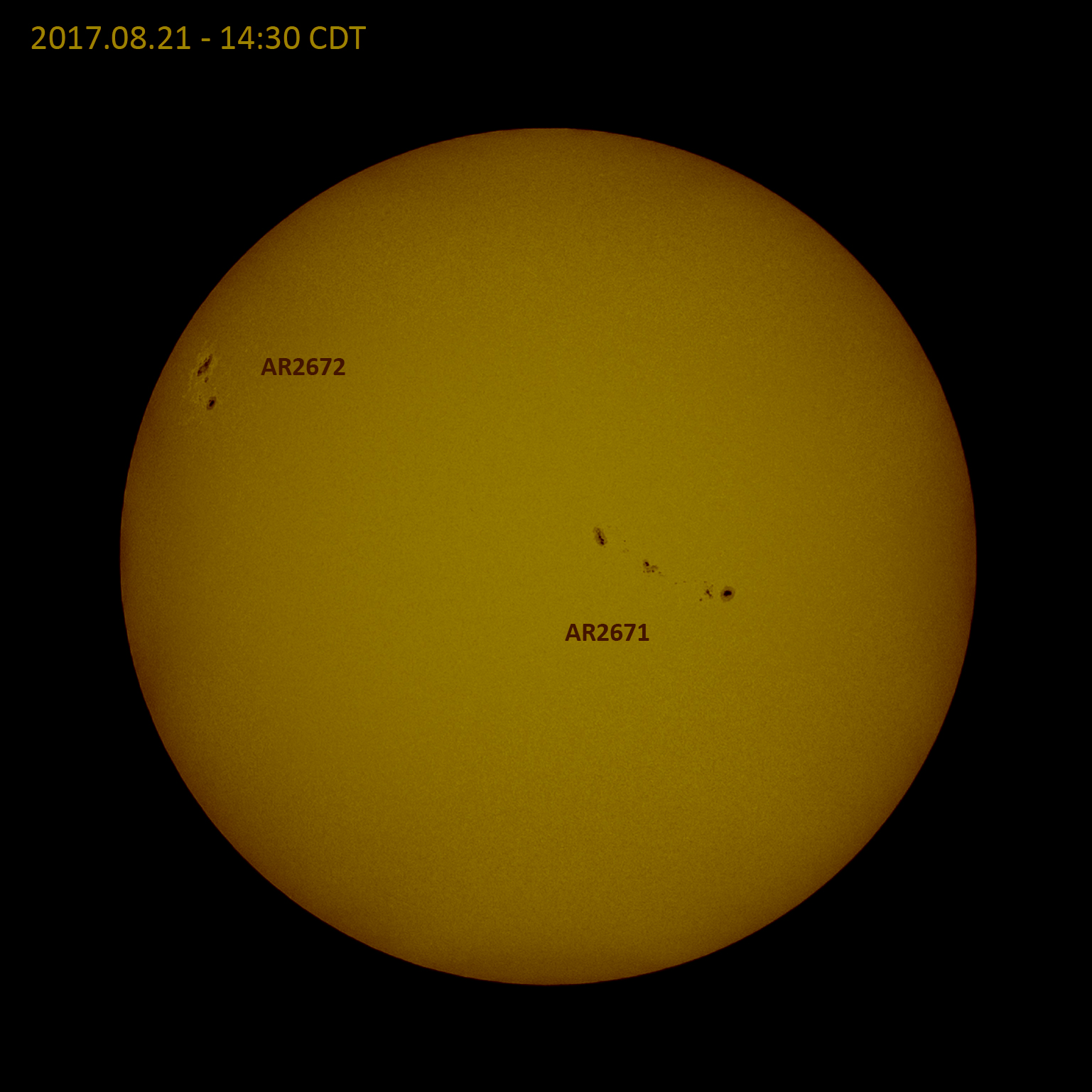
During the total eclipse last month, the sun sported two active regions AR2671 and AR2672. These gave added interest to the partial phase images and, conveniently, gave something detailed to focus the cameras on.
This week, the sun is putting on a great show, especially given the fact that we at a solar minimum right now. The active region AR2673 grew from a single spot to a large naked eye complex and emitted a X2.2 class solar flare at 09:10 UTC and X9.3 class solar flare at 12:02 UTC, Sept 6. A coronal mass ejection (CME) was emitted towards earth and should produce lower latitude auroras and has caused radio interference. Sky and Telescope has a nice article.
I pulled the solar filters out this morning and took some white light images. Too bad, I have not yet put my H-alpha scope back into working order. I brought a pair of solar-filtered binoculars to the office to share the view of the big sunspots with my colleagues. In addition to AR2673, another region AR2674 is also very prominent visually if not violently.
A cropped view shows the two regions more clearly. Amazing to consider that the AR2673 region itself is about 8 earth diameters across.
Image taken with Canon 7D MkII (ISO-100, 1/400s), Canon 100-400mm f/5.6 and 1.4x Extender II (560mm f/8), Baader solar filter. White light images colorized in Photoshop to enhance contrast.
After 24 hours, the active regions have rotated nearly to the limb. The shapes have changed slightly but not dissipated.
A year ago, Danielle and I started planning with her brother Ross and his wife Jill an "expedition" to see the Great American Eclipse. However, we never guessed the amount of hype that would be generated around this event.
After nearly a year of preparation and anticipation, Danielle and I headed towards Nebraska to meet up with Ross and Jill. Based on past weather data, and proximity to Texas and Colorado, we had agreed to all camp in western Nebraska and to strike out from there to a suitable viewing location. Ross made the reservations a year in advance in anticipation of some difficulty in finding the accommodations we wanted, and even that far out he had problems finding two sites with electricity next to each other. We wound up with reservations at Lake McConaughy near Ogallala, west of North Platte, which seemed ideal. Access to the interstate, state highways, and backroads meant that we had flexibility even if the site itself was on the far outer fringe of the path of totality.
In the months leading up to the the eclipse, I tested various equipment configurations similar to the one I brought to the transit of Venus in Hawaii. However, due to the low solar activity, I decided to leave the H-alpha scope at home and set up a wide field camera. I even used my new mini 3-D printer to create custom solar filters, solar finders, and other nifty accessories.
We have had experience with various forms of astrophotography, including partial eclipses. However, this was to be our first total eclipse. In preparation, we read everything we could find on-line about eclipse camera work. We attended the Sky and Telescope webinars "Basic Eclipse Photography" and "Advanced Eclipse Photography" by Fred Espenak. We also read the e-book "How To Photograph the Solar Eclipse" by Alan Dyer. These gave us excellent information about techniques for both acquiring and processing images.
As we got ready to leave, we packed all of the imaging equipment we had gathered into the back of the Jeep, treating it like a trailer for the trip. We ended up bringing five tripods, a equatorial mount, four DSLR cameras, several lens, a small refractor telescope, as well as our birding binoculars and spotting scopes outfitted for solar viewing. We also packed enough supplies to rough it in the back country of the Crescent Lake NWR, our expected viewing location.
We decided to take the trip slowly and make several stops. We hoped to do some birding along the way, though August is not a great time for birding. Our first stop was Lake Thunderbird near Oklahoma City. This was a pretty location but I was disappointed by all of the trash and beer cans everywhere. We ended up parking next to an identical Vista/Sunstar 29VE. The evening was spent finding a few birds, watching a thunderstorm roll by and seeing a nice sunset. The population of Western Kingbirds and Scissor-tailed Flycatchers far out-numbered the campers.
This location proved to be one of the few that we did not reschedule. Our next stop was planned to be Glen Elder, KS. However, as we got closer, we decided that driving the RV for hundreds of miles along narrow two lane roads with no shoulder was not going to be pleasant. We changed our second camping location to the KOA in Grand Island. The KOA was right on center-line but they had been booked up for the 21st over 15 months ago so no keeping that site through Monday.
One more trip leg and we got to Lake McConaughy. We enjoyed a bit of birding there including watching two nests of Barn Swallows fledge during our stay. Ross and Jill joined us on our second day and we set up a nice family camp to share evening meals
On Friday morning at the Lake McConaughy site, Danielle and I practiced with some of our equipment to get a look at the sun. I was excited to see a new sunspot complex had developed (AR2671). This meant that we would have something sharp to focus the cameras on come observing day ... though the weather forecasts were starting to look grim for us.
In the afternoon, we explored the Sandhills of Nebraska, looking for possible observing sites. While on this excursion, we passed this guy hauling porta potties to one of the organized viewing sites.
Ross and Jill joined us late Friday night. As the threat of clouds in "our" part of Nebraska continued to grow, we decided to hedge our bets and book a paid viewing spot at the golf course in Stapleton, NE, on or near the centerline of the path of totality. This was, ironically, one of the first locations I had scouted on Google Maps before finding out that they were having a viewing extravaganza in that did not look friendly to groups with a large amount of equipment. However, once we got there, the golf-course site looked very promising and we were promised adequate room to set up our equipment. Moreover they were serving alcohol, the better for people to drown their sorrows if no break in the clouds materialized. Our scouting trip also netted us a nice Red-tailed Hawk along the way and a bunch of Horned Larks at the golf course.
On Saturday, we took a rest from obsessing over clouds to go birding around Lake Ogallala. On this trip we saw a few new species including "Woody" the Red-headed Woodpecker. I also got a nice shot of a Bell's Vireo near the fish cleaning station.
On Sunday morning, we had our final "council of war" regarding the cloud forecasts. We finally found a use for the big TV in the RV, projecting a screen shot of NOAA web-pages. The forecast now ruled out Crescent Lake NWR and put Stapleton into question. Our other option, heading west into Wyoming, was a non-starter because of the expected hordes of people driving to Casper from Denver. The best spot was looking like Grand Island ... how ironic that we were just there.
Danielle found a Boy Scout camp near Grand Island that was still offering cheap dry camping in their fields. We decided to book yet another spot for Sunday and Monday nights. We broke camp after lunch, abandoned our reservations and headed four hours back east ...
... and arrived at Camp Augustine near Doniphan, NE in the early evening.
There, we had a nice uncrowded spot to camp and view. The location was pretty prime, being almost directly on the center-line of totality, as was Stapleton.
Unfortunately, the freshly mowed dried grass aggravated my asthma and the lack of A/C made all of us miserable, especially Danielle with her heat sensitivity. After a sleepless night, we trundled all of our stuff over to the camp parade grounds, the official viewing location. The main viewing location in Grand Island was at the Stuhr Museum and was reported to be very crowded. Our location was unadvertised and I saw around 50 people on the parade grounds. The drone image below is from a frame of a video shot by Jim Ketchum during the event. I linked to the full video on YouTube at the end of this blog
Our collection of equipment drew several neighboring groups over to see what we were doing. This was great as we were able to share some views in the spotting scope and meet some very nice folks. This small but enthusiastic crowd made the viewing experience more enjoyable than our original plan of observing from the boonies.
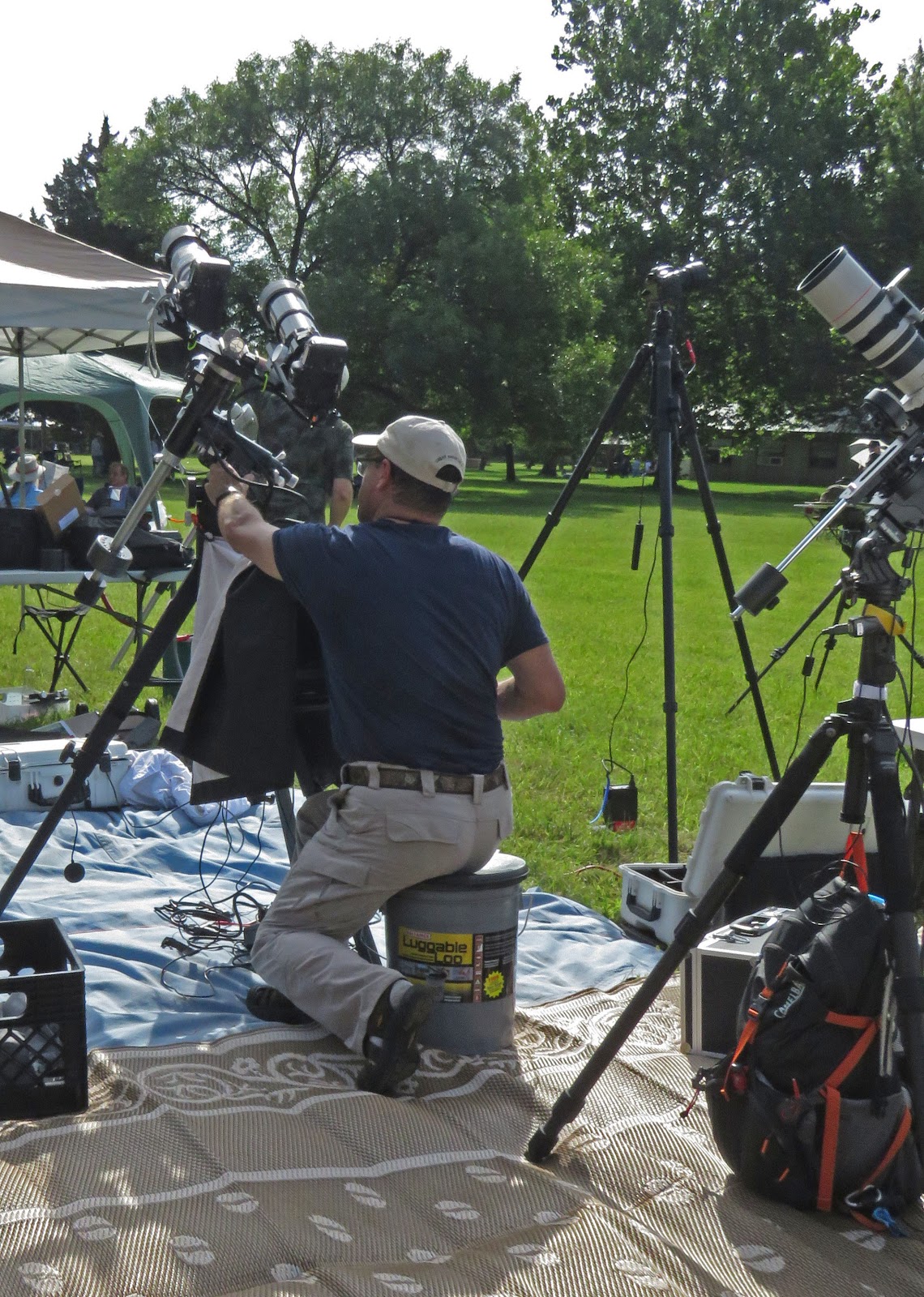
After several nerve-wracking technical problems with the equipment, we got most of it set up in time for the event. As forecasted, there were many high wispy clouds, but we could still see the sun. Thankfully, there were no thick, low clouds. Here is my main setup consisting of a Canon 7D MkII and an Orion ED80CF telescope on the right and a Canon 60Da and 100-400mm lens on the left. Both are mounted on on the equatorial mount and connected to the laptop. The tall tripod beyond me was for a Canon 450D and Rokinon 10mm f/2.8 lens for wide-field shots.
The Canon 7D shots were automated though Eclipse Orchestrator, which despite many rounds of practice, gave me a few problems. Here is a screen shot showing the simulated progress of the eclipse and upcoming shots to be taken. I did not get the mount fully aligned in time and had to manually recenter the image every 5 to 10 minutes. Nonetheless, this automation was great for getting correctly timed partial-eclipse images and for high-rate imaging across the duration of totality.
Finally, the anticipated moment came. For me, totality was everything it was cracked up to be. There is just no comparison between a partial and total eclipse. In the minutes leading up to totality, we observed many of the classic effects. The temperature dropped slowly (I measured a drop of 6 deg F), the wind kicked up, and the nature of the ambient light became indescribably strange. I tried but did not observe shadow bands on the white sheet we had spread out for the occasion. As totality closed in, I watched the last burst of light shrink down to the diamond ring and then get swallowed rapidly into the lunar disk leaving a black hole in the sky surrounded by the puffy white corona. I looked into the spotting scope and was blown away by the bright red prominences that I could see naked eye ... no H-alpha telescope needed. The event was over far too quickly, with the diamond ring reappearing and brightness returning in mere seconds.
I knew that the eclipse would be a fantastic experience but frankly had no idea how awe-struck I would be. Though the pictures I got were great, they in no way capture the experience of totality. I can see why a primitive culture would grovel in fear and ascribe apocalyptic meaning to such an event.
After the totality, both Ross and I let our cameras complete the imaging of the final sequence of partials while all but a few other doughty observers packed up and left. Some of our neighbors graciously took our family picture with our paper glasses on. Actually, this is the only time I used mine. I did my visual observing through binoculars and the spotting telescope which gave fantastic views.
Ross had cleverly remembered to bring some Corona Beers which we emptied out to respect the Boy Scout alcohol-free policy. We could not pass up the pun to toast the solar eclipse with "corona" beer.
At the end of the day, we decided it would not be prudent to dry camp again as we were all heat exhausted. Danielle was able to get us reservations at the KOA in Grand Island again for Monday night and we packed up for the short 5 mile drive there. That's right, Monday night we were booked in three different campgrounds.
The rest of our trip home was uneventful, though we did not stop at any of our previously booked sites. Instead, we ended up at a KOA in Wellington KS and then a night at the Eisenhower SP on lake Texoma in Texas. All told, we put over 2000 miles on the motorhome.
Once home, we began to process our images. Despite the clouds and technical screw-ups, we were both pleased with our results. During totality, I had taken a panorama of part of the 360 degree sunset we experienced. This view is towards the north-west in the direction from which the moon's shadow arrived. Our setup is at the right of the image where you can make out the glow of our laptops.
This next shot shows the Diamond Ring effect at the C3 contact point (end of totality). The sun is just peeking back out creating a brilliant glow but the corona is still visible. This is the point at which the solar glasses have to go back on. This image best represents my memory of the naked eye view of the sun.
An image taken moments before and with faster shutter speed show the Baily's Beads, a series of bright spots where the sun's bright photosphere peeks out between mountain peaks along the limb of the moon. The red glowing line is the thin chromosphere of the sun. You can also see several red prominences arcing out from the surface. These phenomenon go by very quickly so computer control of the camera was essential.
During totality, using fast shutter speed, I got this image of several nice prominences. I was not expecting this many since the sun is a its minimum point in the solar activity cycle. This image best represents what I remember seeing in the spotting scope.
This next composite shows the Bailey's Beads at the beginning and end of totality as well as the prominences during totality.
The cloud cover made corona imaging more challenging. Despite this, I was pleased with the results. The image below is composed of nine different exposure levels from 1/200s down to 1.6s. I spent some time researching various imaging processing approaches and came up with a variation of the method described by F. Espenak which is based on high-pass filter created by subtracting from each image a spin-blurred copy of the same image. Each of exposures was separately processed this way and the difference images combined to show the overall "structure" of the corona. Faster exposures show the detail near the sun, slower exposures further from the sun. All of this processing was done in Photoshop using simple Apply Image commands and layer blending modes.
During the partial phases, I captured images though a solar filter made from Baader solar film. I combined these into one large composite, colorizing the partials. You can follow the time progression from left to right though with some artistic liberty as it does not show the moon's path crossing obliquely though the sun's path. Note the clouds passing over some of the image in the early part of the eclipse and two sets of sunspots!
The wide-field camera did not give me the images that I had originally planned. Rather than showing the planets and bright stars as I had hoped, it showed clouds. This turned out to be a great thing. The clouds dramatically captured the progression of the moons shadow passing over head as this sequence of images shows. Here, the second and fourth images correspond to C2 and C3 as the shadow crosses the sun. At totality, you can again see the sunset colors in the distance.
These frames are extracted from a series of shots taken every 1sec over a period of 7 minutes around totality. I used then used LRTimeLapse 4.7 to combine these into a video showing the progression of the shadow. I find this video to be fascinating.
Browsing on YouTube we found this drone video by Jim Ketchum that shows our campsite and our equipment setup on the parade grounds ...very cool! I hadn't even noticed the drone flying nearby.
We are now starting to plan for the 2024 eclipse that will pass through Texas. Though this one will give us over two minutes of totality at our house, we will make sure we have more contingency plans made ahead of time. There are several state parks that lie near the center line
You can read Ross's account on his blog which has a great 180 degree fish-eye view of the sky. Danielle posted her photos on Facebook.
We put our dear companion Vali to sleep today. He was diagnosed with primary lung cancer a couple of months ago. Words cannot describe the loss I feel.
The chicks have now fledged and are flying ... sort of. They are not very graceful but they are making forays out of the nest tree towards the river. I saw one land on the roof of the house this morning. I am not sure where they roost in general.
This evening, I got some pictures of one of the fledglings feeding on a snake by itself, a couple of trees away from the nest. I am not sure if it caught the snake itself, though.
I also found this collection of feathers, part of a wing, and a claw below the nest. I think this might be an Eastern Screech Owl, but am really not sure. The patterning looks close to one I found in a feather atlas. The talon has feathering on the toes, also consistent with some sort of owl. The prey is a bit out of the ordinary for the Red-shouldered Hawk, but not unheard of according to this Wikipedia article.
This morning, two of the chicks in gourd #1 fledged, one about 9:30 and the other at about 13:00. This evening, the five resident adults and two fledglings made passes around the colony before dispersing. Tonight, the male martin is taking care of the two remaining chicks and the female is presumably off roosting with the two escapees.
Meanwhile, in gourd #3, the female has laid her first egg. This is the new mate of the male whose previous mate was killed by Starlings. As far as I can tell from videos, the male has yet to succeed in entering an unmodified gourd. I am a little worried about how this pair is going to feed its chicks.
Update June 9 - Third martin from gourd #1 fledged today at 17:40. As I watched later from outside, the last chick was making thrusting attempts to get out of the hole. These were especially frenetic when the rest of the family was chirping and strafing the colony.
In gourd #3, a second egg was laid at 09:30. This female lays much later in the morning than the last two broods I have watched.
Update June 12 - This pair in gourd #3 seems to have abandoned the nest with no further eggs.